A Wargaming, Warhammer AoS, WH40k, and other miniatures hobby blog. I like to review products, talk about things going on in the hobby world, and hopefully help people with modelling hints and tips.
Sunday, October 25, 2020
Friday, October 11, 2019
Narrative Events
What is this, anyway?
This is just a short article that covers some of the areas of Narrative gaming and how you can best prepare to be a part of it. Narrative gaming should be fun, but some people get anxious about whether or not they ‘narrative well enough’. Rest assured, you do and it’s not all that hard. You can jump in at any level and put as much into it as you like. Just remember, what you get out of a narrative event is proportionate to what you put in.What is narrative gaming, and what it isn’t?
This is a relatively simple question that has no simple answer, however, you can think of it like this. A competitive game of AoS is two warlords fighting a battle to see who the better warlord is (i.e. better at pushing their plastic army men around). A Narrative game/event however, is more akin to two generals fighting a war, complete with all the problems that wars bring (conflicting objectives, politics, logistics etc.).
Naturally, a narrative event is much more like two players, telling a story together. To tell that story, the players will have to combine two concepts that have always existed in narrative gaming, the Embedded narrative and the Emergent narrative.
The Embedded narrative is all the pre-generated content that exists prior to a player’s interaction. This is basically the backstory, the setting, maybe some maps or other ‘props’. It boils down to the ‘setting’ you will be playing in. GW is creating a lot of this for us, with the Realms and their campaign settings (Malign Portents, Forbidden Power, Firestorm et al). Narrative Event Organizers (NEOs) do this for the events they create.
The Emergent narrative is what arises from the players interaction with the game world and occurs moment-by-moment. Many of us NEOs refer to it as ‘when the players start destroying the setting’. The key thing to remember about the emergent narrative is that it will vary from player to player as they push their own, and perhaps the organizer’s agendas and boundaries. The emergent part of the narrative is what makes the event fun for everyone. It is how the story evolves and takes everyone for a ride.
How to prepare for a narrative event
So how do you get ready for a narrative event? Simple answer, however you want, but it should include at least a good backstory for your army. Once you know what the embedded narrative elements are, you should look at your existing narrative army. You need to see how you will fit your army into the existing narrative elements. (If this is your first event, maybe you have to create an army from scratch, more on this later).For starters, ask yourself some questions;
- Why does my army exist?
- Why is it here, in this place, fighting for these goals?
- Why is my warlord here and what do they hope to accomplish?
- What is my army’s overall goal and is the same or similar to the campaign goal?
Once you know these answers, even vaguely, you can craft your backstory. For some folks, this is nothing more than a sentence or two. For others, it can be a full multi-media extravaganza with army lists published in magazine format, videos and the like (I’m pointing at you, Mr. Steve Foote, master narrativer). This is another area where the more effort you put in, the easier it will be for you to fold your army into a narrative event or campaign.
Prepare to be challenged, but never be the judge. As you enter the event or campaign and meet the like-minded folks that will be going on this narrative journey, make sure to have an open mind. Never look down on anyone else’s level of preparation, and certainly, don’t judge. Some folks may be new at this and not have your level of preparation or effort. They may also have four kids and no time to dedicate to generating a rich and multi-media backstory. It is never helpful for someone to preach at another player on ‘how to narrative better’. Of course, if you have real constructive criticism, find out if they want your input, and then freely give it. We’re all here to help others tell a story together.
How to make a list
If you don’t already have a list for your narrative, here are a few things to think about. First and foremost, you don’t have to dumb it down or make a ‘soft list’ for your narrative army. What you do need to do is try to make it make sense, given the embedded narrative. Think about the backstory you have been presented with and how your army might fit into that.If the backstory has elements of ‘your army has been stranded in this desolate waste for years, searching for an escape’, then perhaps you may want to have more elite forces and less of the ‘ground-pounder’ troops. After all, the weak would have perished and only the strongest and hardiest would still be around, looking for a way out. Conversely, if the narrative is more like ‘your army has just arrived in the area…’ you may want a preponderance of troops, and few of the more powerful units. After all, this excursion may be nothing and those powerful forces are needed elsewhere.
The biggest thing to think about is the point limits. Try to have a decent ratio of the ‘tough as nails’ to ‘squishy objective holders’ in your list and carry it forward as you grow your army, if the campaign or event has a growth mechanism. If the system you have penalizes losses, meaning you have to spend glory/coin or some other currency for replacements, it will usually be cheaper to replace troops than elites.
At this point, you may also want to start thinking about your goals. Not victory conditions, but rather, goals. Is your goal to grow this army to gargantuan size and slaughter all before you? Perhaps the goal is to escape a desolate waste or enemy controlled area. When you choose an army, try to think about what kind of units will help you achieve that goal. If you’re on the run, pursued by the enemy, then you may not want to have slow, ponderous monsters in your list. If you are the pursuers, you may want to look for fast cavalry units and speedy, hit-and-run units.
These are the sorts of things to think about. Many NEOs will tell you that you should build an army to a certain point limit, but they may also say not to worry about the ‘matched-play restrictions’. Of course, the power gamers would spam the best units in the game at this point to try to wreck face at the event. But we’re narrative players, we’re not going to do that, right?
But what if it makes sense? What if, narratively, your army should consist of all one type of unit? Talk it over with the NEO! If you have a good idea. Maybe between the two of you, you can come up with some limitations that would make the game fun for both players, and still let you have nothing but a certain unit. If it is an especially powerful unit, perhaps you are plagued by ammo or power shortages and only one quarter of your force can move or shoot in each turn. If it is a common troop type, perhaps they are exhausted and cannot run or charge during the game?
These are just ideas, but they may help to spark a thought for you. The idea is to make a fun list that you will enjoy playing, and your opponent will enjoy playing against. If your list is full of the absolutely latest, greatest beasties ramped up with excess power from previous games and won glories, are you in the right place? Are you helping to tell a story on the table, or are you trying to dictate a story to your opponent? If the latter, maybe you should have bought a ticket to the GT?
How to approach the game
So, you have your list, you have your tickets and you’re at the event. You line up for your first game. You gaze into your opponent’s steely eyes, sensing the desire to slaughter… Wait, that was the GT again. So you rock up to the table with your opponent and you look at the battleplan. If you’re really playing a narrative game, then this battleplan is a suggestion to you and your opponent on how to get things rolling.
So now is when you recall your objectives and talk about them with your opponent. The NEO has probably poured blood sweat and tears into making all these battleplans, so do try to live up to the spirit and the letter of the plan. However, with your opponent, make sure that you both can work your army into this battleplan. Maybe you need to set up some objectives, not victory conditions for this game to work between you. Maybe the battleplan looks great as it is and you can play it straight up.
Work with your opponent to make sure you can both tell a combined story and neither one of you is going to be ‘handed your butt’ because of the set-up rules or victory conditions. If it is going to be one sided, maybe make a rule that says your opponent’s first dead unit gets to re-enter without summoning points or some other mechanic.
Then there is the ‘skill equivalence’. This is always a tough nut to crack. If you know that you are a far better player than your opponent, or vice-versa, you may need to establish a handicap of some sort. Of course, if you just think you’re better, maybe it’s best to play a round or two first. But if you know the story, perhaps it’s your opponent’s first organized game ever, take that into account… nuff said.
As you play the game, play the game to win, but also play to tell the story. A fact of life is that we play games to test our skills, tell a story and have a good time. Winning the game should never be looked upon as a bad thing or something to avoid because you’re ‘a narrative player’. You should be trying to achieve two things, the victory conditions of the battleplan and the objectives that you have for your narrative army. Too many NEOs think that playing to win is a bad thing. Playing obsessively to win is a bad thing. But in every game there is a winner and a loser, it’s why we have tie-breakers and very few draws.
If you find yourself concentrating too much on the win, maybe it’s time to pump the brakes. Look at your opponents face and their body language. Are they laughing and joking with you, or laughing at your crazy ‘luck’. Are they sharing the experience or an unwilling participant trying to keep up? If you get the sense that not all is well, you’re probably right. It may be time to take a break and talk about the game going forward. Perhaps your opponent is almost tabled and it’s time to give them a path to victory that may not be in the battleplan? Maybe there is a way to have them achieve a goal or objective to salvage something out of a bad set of die rolls, or poor decisions?
Remember, you’re telling a story with two authors, don’t be the jerk that monopolizes the story completely to your narrative. Conversely, if someone is railroading you, don’t hesitate to look over and say, ‘hey this isn’t working well for me.’ Narrative games are two way streets. It’s never wrong to call over the NEO and explain that this is just not working for you.
How to find the limits
I don’t exactly mean the limits here, but I do mean you should feel free to poke around the edges and have a little fun with your story. Work with your opponent to tell the story that you both want to tell. If you cannot do that in the boundaries of the battleplan or the embedded narrative, flag down a NEO and work with them to bring your story to life.As long as you and your opponent agree to a change you propose, you should feel relatively free to vary from the printed battleplans. If you both think there needs to be an extra objective on the board, feel free to add it. If you think a separate deployment plan is needed, try it.
Do keep in mind, in those battleplans or events that have a growth mechanism (i.e. the award of coin/glory or any currency used to enhance your army during the campaign.) you may need to involve the NEO. The battleplans may be balanced in a certain way to prevent an overabundance of currency.
In short, you should feel free to ask your opponent, or the NEO to do anything. Even to the point of transferring a unit from one game table to another. The NEO may decide to attach some strings, make a die roll or even charge currency, but asking never hurts. All they can do is say no. But most NEOs will be willing to at least discuss any ideas you have, and if you and your opponent agree on it, then they will most likely approve anything. Push the boundaries!
How to end the game
So, the game is finally over, there was much shenanigans, hooting and hollering and general mayhem. You lost by one lousy victory point, but the game was a smashing success. Everyone had fun. But, life is what it is. The other guy won and gets more points/currency/loot etc. So how do you snatch victory from the Beastclaw Raider jaws of failure?Well, did you achieve any of your army’s objectives? Remember those from a while back? Maybe you set an objective to explore all four corners of the board. If you were able to do that, you can say you lost the battle but you’re achieving the primary goals of your army.
So, why am I telling you to lie to yourself to feel better about losing? Well, this is where you have to involve the NEO and maybe even your opponent. Did you let the NEO know you had a list of side objectives before the event? Did you have a backstory that narratively told the NEO what you were REALLY after in this event? If you did, maybe you’ll get some real currency for it. Maybe you’ll just get a smile and a nod, but remember, this is your story to tell. Your army is your story to craft, the game is just a single chapter of your army history that the other guy helped write!
Maybe the victory conditions for the battleplan didn’t even apply to your story. I’m not saying you should play with your own set of victory conditions, but if the result of the battle can be made to tell a better story for your army, who cares about the victory? For instance, we’ll say your General died in the battle, a glorious last stand but eventual death of a beloved war-leader. Well, now it’s time to groom the next guy in line to be the new beloved general. If there is currency in your event, maybe toss a few coins at your ‘new’ General to make him a little better, give him a better chance in the next battle, since he learned what killed the last general.
So, if there is growth potential in the event, you now have a roadmap to getting stronger. Sure, you took your lumps in this battle, but you’re going to be all the stronger going forward.
How to keep it going
So, you’ve played a few narrative games, your army has gone through some changes, names have changed. What will your army do now? Well, if you’re in the middle of an event or campaign, you have to, most likely, keep going with them. But now is the time to start thinking about where this army will end up.Does the event have a mechanic where you have to use currency to replace losses or bring on replacements? Maybe you start to change the complexion of your force. If you were not fast enough in the last game, maybe some cavalry is in order. If perhaps you were too fast for your opponent(s), maybe you move that elite cavalry unit to another front in this great war and take a unit of slower foot soldiers. Remember, the idea is for everyone to have fun, if you are 3-0 and have smashed all your opponents leaving them with sad faces, drop from the event and join the GT, you’re not here for the right reasons.
If you have the resources, and find that your winning too much, or too easily, maybe part of your army needs to be recalled to attend the victory parade. Maybe even your general has to go receive the laurel wreath of victory from the king. You’ll need to promote another hero from your army to take over I his stead?
If you find yourself on the short end of the victory slider, maybe you need to flag down the NEO and negotiate a handicap, or perhaps an edge to help you out. Maybe discuss with your next opponent some mechanic to even things out. So, monsters cannot take objectives in this battleplan, maybe one of yours can for a while, the possibilities are endless. Remember, the story is the thing, not the win/loss column.
To sum it all up, remember these things about a narrative event/game.
- You’re there to tell a great tale of adventure, heroism and world shaping events, as well as having fun!
- Make sure you and your opponent are sharing the fun. Watch their body language and attitudes. If they are just going through the motions, take a break and talk it out.
- Engage with the NEO and your opponent to break some rules, push some boundaries and take the story to new places. Most NEOs are more than willing to kill their darlings if it will enhance the storyline for everyone.
- Win if you can, lose if you must, but always make it fun!
Friday, December 21, 2018
Yearly Chaos Incursion: Target Identified - S. Clause
*+*+*+*+*+*+*+*+*+*+*+*+*
Begin Transmission
Repetition of General Directive 264-A-XCIV
To: Distribution, Sectorium Primus
From: Office of The Grand Inquisitor, Ebineezar Grinchanius
Re: Yearly Chaos Incursion
This purpose of this notice is to remind the forgetful of the annual visitation by the minion of Chaos known to the unworthy as Santa Claus.
+++ The Emperor's Light Banishes the Shadows of Heresy +++
As the diligent will recall, the incursion occurs regularly every 8742 to
8766 Terran hours, roughly corresponding to a Terran year. This trespass has
occurred with disturbing regularity since at least the Horus Heresy, and
perhaps longer, as many records were misplaced.
+++ Love and Obey the Emperor +++
The faithful will recognize the target on sight, as his garb and gear mark
him immediately as an agent of the abominations.
Santa Claus is a corpulent, bloated creature approximating the human form.
It wears a crimson tunic the color of fresh blood, marking him as a possible
follower of Khorne. It is bearded, mocking the honorable Squats, and its
hair is a sallow shade of gray, betraying its unnatural age. Be advised that
despite the creatures fearsome name, no claws have been observed, and the
former is likely a ruse.
The target has been observed in the company of smaller creatures having the
appearance of thin (less than 30 kg, approx.), stunted (1.5 meters)
humanoids with pointed ears. Their appearance suggests the involvement of
the decadent panzee, and although that race denies involvement (*reference
the Rudolphian Campaign [index 4111-BGE-MMXCII-Primus], specifically the
Battle of Yukon Coneliaus IV [ibid., index 6]*), agents are advised to be
prepared for their involvement, as the panzee are known for their deceitful
ways.
Santa Claus is conveyed by means of a grav-sled powered by unnatural
livestock as detailed below.
The target's vehicle is a grav-sled. It has superfluous runners which are
used only on landing and take-off. Despite the appearance, no frozen water
is necessary for its operation (another ruse). The vehicle's resemblance to
the foul Palanquin of Nurgle should not be discounted, even though the
colors continue to be reminiscent of Khorne.
The device is powered by the unholy ministrations of eight or nine
quadrupeds. Ordo Malleus scholars have identified these creatures as warped
versions of an extinct species of Terran mammal known as a Moose (reference
900002-ER-CIV). These beings single-mindedly pull the target's vehicle
during its yearly invasion. They are outfitted with belled harnesses which
are apparently imbued with the ability of flight. These beasts have been
likened to the Fiends of Slaanesh, and such a comparison should not be
dismissed too lightly, as the creatures shed a luminous substance as
effluent as they move. Inquisitors should take care to avoid exposure.
Perhaps more disturbing is the variable number of the minion-creatures. On
occasion, a ninth Moose has been observed, placed before the other Mooses.
This creature radiates a sickly reddish glow from its snout, as a psychic
beacon to other followers of the Vile Ones. This Chaotic device has allowed
the target to navigate despite our best efforts to jam its navigation
systems.
+++ Blessed is the Virtue of Blind Faith +++
Santa Claus gains entry to the domiciles of loyal Imperial Citizens (see
below) and leaves small Chaos Rewards to tempt the faithful.
Inquisitors are reminded to confiscate and incinerate these items before any
lasting damage is done. As a localized temporal distortion field is in
effect around the target, these items are secreted in the habitations of the
Imperium at exactly 2400 hours in every location defiled by the creature. It
is therefore possible to gain entry to the citizens' quarters and remove the
items (often cunningly hidden in footwear) before the citizens are aware of
the heresy that has been committed upon them.
In other cases, removal of the items after the citizens have discovered them
is possible. In such situations, small children are occasionally loath to
surrender the items, as the tainting of the juveniles has already begun.
Executions of the above are to be handled in the most expedient manner
possible.
Often, juveniles that are well within the Emperor's Grace are given small
blocks of graphite ore rather than the more tempting gifts visited upon the
less faithful. The identity of these individuals are to be recorded, as
future recruitment into the Inquisition or Adeptus Terra is possible [Note:
Inquisitors or other agents who do *not* receive the graphite stones should
be watched carefully].
Santa Claus enters the domiciles be way of heating ducts and waste vents.
The size of the opening is not a factor, as the creature can adjust its mass
and displacement by means of psychic manipulation. Mining these openings
with frag, krak and other demolitions has proven unsuccessful.
The creature egresses by the same means, after ritually caressing his
nostrils. No mucus has ever been recovered.
+++ The Death of Emperor's Enemies is the Only Gift We Can Give +++
Although all previous attempts at the destruction of Santa Claus have
failed, Inquisitors are urged to make such an attempt whenever possible.
However, of more importance is the suppression of cultist activity
associated with the yearly incursion. The Tainted have been known to erect
shrines in their homes in the form of shrubbery adorned with baubles and
lights [Note: the shrubbery is often highly inflammable, and offers a
discrete method of executing the offending heretics without calling undue
attention to the operation].
Other warning signs include:
Hallucinations involving sugared candies during slumber;
Excessive singing;
References to "a magical time of year" (note the influence of Tzeentch);
The construction of effigies made of snow; and
The performance of Slaanishi rituals while underneath plant clippings of the
genus Phoradendron flavescens.
Once again, executions should be handled in an expedient manner.
+++The Emperor Protects+++
End Transmission
*+*+*+*+*+*+*+*+*+*+*+*+*
Thursday, December 13, 2018
Building the Astraeus Super Heavy Tank - Forgeworld
So. I did a thing when I went to the GW New
Hobbyist Expo in Texas. I bought a
Thunderhawk. Yeah, needed that like
another bolter shell in the head. But I
have always wanted one, so I did it. To
lessen my feelings of guilt and shame, I made myself swear to finish the
Astraeus I got for Christmas first. So
herein lies my tale of building the model and how the new ForgeWorld kits are.
Overview
First off, let me
say this. This kit is a HUGE hunk of
Resin and the quality difference between now and just a few years ago is
amazing. Nothing was warped that had any
size to it. A couple of gun barrels, and
the main gun barrels needed a little straightening, but it was by no means like
it used to be. If you used to be
apprehensive about buying ForgeWorld big ticket items, don’t be anymore. This kit and the Thunderhawk are beautiful,
detailed and needed almost no re-working at all.
Next, assembly
gaps. Yes, there are gaps in the
finished product. You will have to
green-stuff or putty little joins here and there. This is a fact of life with these resin kits,
and I’ll not devolve into the merits of resin v plastic. These are fun models that need a bit more
hobby proficiency than the shake the box kits that GW makes. But half the joy is in the assembly, so it’s
kinda what I paid for at least.
The new manuals for
assembly are about 3257% better than the old photocopied crap instructions that
used to be in these kits. The new
manuals are full color, they show the parts very clearly. They also take care to overlay colors onto
the areas you should glue, and areas where resin will need to be removed to
make it look or fit right. There are
also notes and callouts where the assembly can be fiddly, or where something
needs to be done to make the final piece have movement or elevate properly.
So, the grade for
the kit overall is a solid A
Assembly notes.
I would suggest
magnetizing all the weapon options for the tank in a big way. It’s nice to have options and this is resin,
it’s easy to drill the holes and easier to mount the magnets. If you don’t have the magnets, I would
suggest either MagSavvy.com or the MagnetBaron.com.
I also magnetized
the sponsons into the side of the vehicle.
The fit is a little loose overall, and I did not want to glue the
sponsons in. The assembly itself has
‘ridges’ in the holes for the sponsons and the sponsons have splines that will
hold them in different elevations. They
are reasonably thick, but I preferred to put a magnet in there to hold it
better.
Turret weight
The turret is the
first thing you build and it needs a few tweaks, at least mine did. The weight of whole assembly is definitely
toward the rear, and the guns are not long enough for the moment of inertia to
equalize the weight. So, they tend to
slam down and always point up.
Since friction is
really cool, all I did was take some very thin plasticard (.10) and made 2
sleeves for the gun turret ‘holes’ to tighten it up and hold the guns in any
position I put them. See the picture.
Glue…
So, for most of the
large body assemblies, I used bamboo skewers as ‘pins’ (the ones I have are
nicely rounded and have a 3/32” diameter).
It was easy to drill with my Tamiya drill and then used 5 minute epoxy
to glue it all up. For almost all the
littler pieces I just used thick super glue.
Keep in mind that
you’ll need to ‘score’ the mating faces no matter which glue type you use. I just used an x-acto hobby knife to make
lines in the faces. It gives the glue
(or epoxy) an extra surface to bite into as it dries and sets.
All in all, assembly was really easy and
straightforward. I’d have to give it a
solid B+. The manual and the new, clean
lines without warpage made it a breeze and done in a couple of evenings.
Painting
I left off all the
repulsor plates, the engines and weapons.
These will be primed separately and be painted then applied. Hopefully, I’ll get to show you a painted
version soon.
So overall, the whole thing gets an A. It’s a great kit.
Friday, November 30, 2018
The care and feeding of brushes, and how to fix them when you don’t.
Using your brushes so that they last a lifetime.
We all know that we need to care for our brushes, but after seeing some things recently, I have come to understand that there are a lot of people who don't know how to just that yet. So here are my guidelines for how to care for your brushes, and what to do if you don't sometimes...
These are guidelines, not rules to live
by. We all have habits, some bad and
some good. These are really just things
to think about was you use your brushes.
I would, however, say things in the ‘never’ list you really should try to avoid
doing.
• Always
o Use
a brush for one medium only. Don’t use the same brushes for oil paints (or oil washes) and then acrylics. The stuff used to clean oil brushes is
pretty harsh (mineral spirits) and will really wear a brush out.
o Always
wet a brush before you start painting.
Don't pick up paint with a dry brush.Unless you're dry-brushing, of course.
o Once
a brush is charged with paint, begin painting with it immediately. This will pull the paint away from the
ferrule.
o Once
you have rinsed a brush, shake out the excess water rather than rubbing or
squeezing it out with a cloth or paper towel.
Never pinch and pull on the tuft with a towel, as this will break or
pull out the hairs.
o Wash
and shape the brush hairs when you finish your work session, using lukewarm
water and a commercial
artists' brush cleaner (links below)
o Treat
synthetic brushes with the same care as natural hair brushes. The rule to never rest a brush on its tip is
even more important with synthetic brushes since they tend to retain any shape they get into.
o Dip
out and mix paints with an old brush or stick, never your best brushes. If you’re mixing on a palette using your good brushes, just be sure
not to get paint up in the ferrule.
• Never
o ‘Reshape’
a brush with scissors or X-Acto blade. Trimming the ends of a natural hair brush leaves them in a 'broken' state and they will never get back to 'normal'.
o Never
hold a loaded brush with the tip pointing upwards. The paint will ‘wick’ towards the ferrule and
make it harder to clean.
o Leave
a brush sitting point down in water
o Leave
a brush wet with paint for extended periods
o Let
it dry out with paint on it especially in the tuft (or ferrule)
o Clean
or rinse a brush in hot water. Hot water
can affect the glue up in the ferrule and allow the hairs to pull out or get
misshaped.
o Avoid
submerging the tuft in paint for long periods. This encourages the capillary
action that causes paint to migrate up the hairs into the ferrule, where it is
difficult to get out.
o Do
not submerge the brush in water beyond the top of the ferrule. Water will seep
into the ferrule from either end. This
could cause the handle to swell, crack, and loosen in the ferrule.
Cleaning brushes correctly
Cleaning is really straightforward,
but if you’re not doing it right, you can really ruin brushes fast. The cheaper the brushes, the more they get
affected by bad practices.
•
Never use hot water! (see above)
•
Use a purpose-made brush soap (Masters or
Jentastic Goop), baby shampoo or something super gentle. Never use hand soap or harsh cleansers.
o Get
the brush good and wet with water, swirl it in the soap until it lathers up a
bit, then brush it in the palm of your hand to ‘scrub’ the bristles. Never jab it or move it in a motion that
would go against the ‘grain’ of the hairs.
Always be ‘pulling’ it toward the natural lay of the hairs.
o Rinse
the soap out carefully in water, swirling it around for a while.
o Once
cleaned, shake excess water from the brush.
Don’t dry a brush by wiping the tuft with a towel. If necessary, shape the brush gently against
the side of your finger so that it comes to a balanced point. Wash brushes need
to be shaken out more assertively, as they hold more water.
o If
you’re crazy like me, now is the time to dip it into some hair conditioner (you’re
wife’s bottle is probably in the shower, go grab a small squeeze of it in a
small seal-able cup. She won’t mind.) Seriously, brushes are just animal hairs, and
they dry out. Conditioner helps them
Remedies - When you don't follow the 'guidelines'
A good brush is
always worth the investment. Not only is the finest quality, natural hair brush a joy to use, it can always be returned to its original
state no matter how bad you treat it. Cheap ‘box
store’ brushes are not so forgiving. Everyone I have met who swears by cheap brushes changes their tune when they
start using quality brushes.
That said, poor care and use of brushes can
lead to them getting really hard to use.
Most often, the head of a brush will start to splay as pigment becomes
trapped between the hairs in the ferrule.
This is what normally keeps them from holding a good point. This will occur if paint is not thoroughly
washed from the brush after every use, or the brush is used too aggressively to
pick up or apply paint. There are ways
to fix this though!
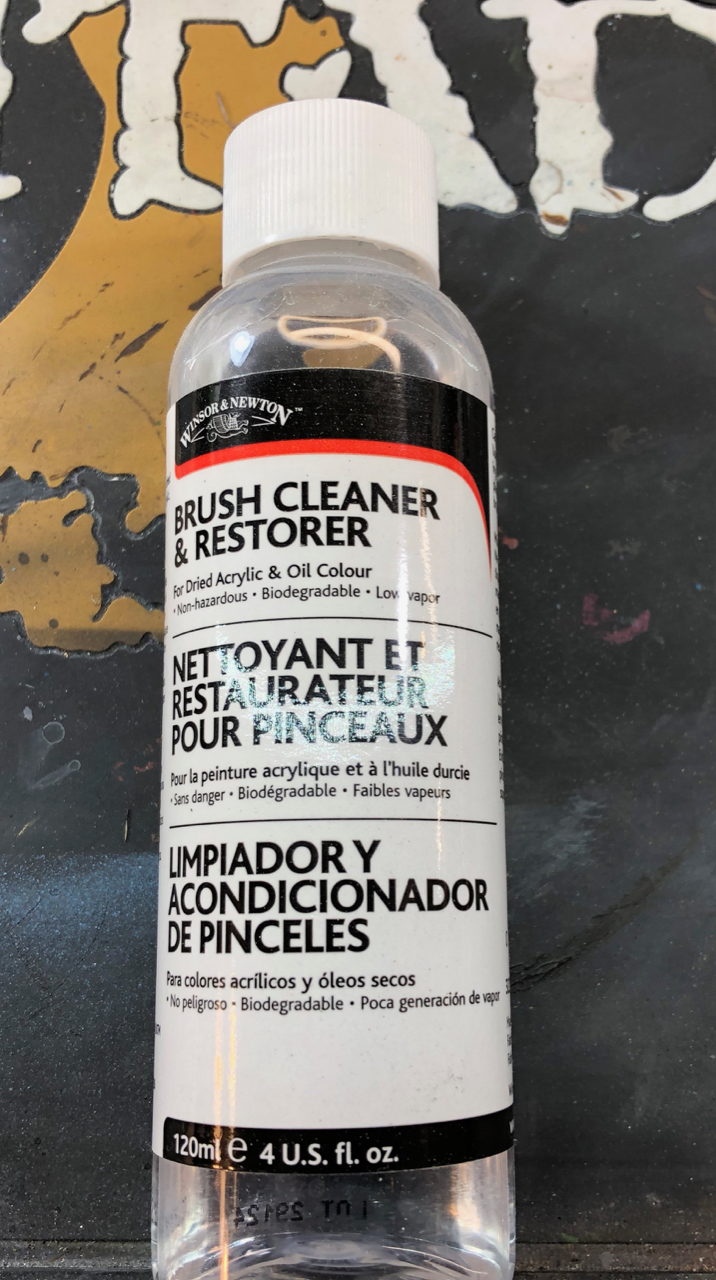
Winsor & Newton sells a brush restorer
chemical that is designed to ‘gently’ eat the paint that has dried in the
ferrule. I have used this stuff with
great success on even some of the most abused brushes (Elric!). All you need to do is put the brush into the
bottle of cleaner (or a separate container, see the photo.) up to and a little
past the ferrule. This will let the
cleaner fluid work the dried acrylic out of the brush. They recommend soaking the brush for hours or
even overnight if need be.
Once it has soaked for a decent period of
time, run through the cleaning cycle.
Use clean water, brush soap and gentle scrubbing.
Hair conditioner
As brushes are used and
cleaned in normal painting, the natural oils in the hairs are worn or washed
away. The usual symptoms are that the hairs will begin to look dried out or
frizzled, the brush will not point as promptly when wet, and stray hairs begin
to appear. Some folks will use brush
soap and actually leave it in the bristles without washing it out. Let it dry them in an hour or so, rinse it
thoroughly. Most times that will work to
recondition the brush.
You can also wet and wash
the brush in lukewarm water and then apply a small amount of hair conditioner
to the wet clean hairs, work it in thoroughly with your fingertips, shape the
brush to a point or flat edge, and let it sit for an hour or so. Thoroughly
rinse out the conditioner and shape the brush to dry, and repeat if necessary.
Brush shaper or Gum arabic.
After washing, if the
hairs or bristles are still crazy splayed out, you can use gum arabic or brush
shaper to shape the brush back to a point (most natural hair brushes come
preshaped with gum Arabic on them and need to be cleaned before use). Dip the brush in the brush shaper or gum
arabic solution, shape with your fingers, and set it down where it can rest
undisturbed to dry. The longer it sits,
the better the result will be. Keep in
mind though, if there is dried paint in the ferrule, it will not stay pointed
for long after this treatment. Go back
to the remedy section.
Stray hairs.
Almost always, just leave
these alone, as long as the brush shapes to a good point and the strays do not
interfere with your brushwork. If you
need to remove a nuisance hair, grip the hair carefully with thumb and finger,
or a pair of tweezers near, the visible base (not the tip) of the hair shaft,
pull it down and to the side against the edge of the ferrule, and snap it off
at the edge, using the ferrule edge to cut it.
Try not to ‘pull it out’ from the ferrule, as it will leave a tiny bit
of a hole in the glue and allow gunk to build up. Don’t try to cut stray hairs with scissors or
a blade, you won’t be able to trim it close to the ferrule without damaging the
tuft.
Never attempt to "trim"
stray hairs by holding the dry brush tuft near or against a flame. This will
very likely burn off other hairs in the tuft and can invisibly blunt the tips
of the hairs in the point as well.
Storage
o Never
store a wet brush upright, the liquid will just wick up into the ferrule and
that’s never good. Leave the brush
horizontal or face down (not resting on the hairs) to dry, then store them
upright.
o Never
store a damp brush in an airtight container. The dampness will cause mildew,
and that will destroy the brush hairs.
Baaad!
o Don't
store brushes near heat (furnace vents, sunlit windows). Heat is not a brush’s friend.
Traveling with brushes
o To
carry brushes on trips, use a brush roll holder or something expressly designed
for that purpose. Lots of companies sell
roll up or zippered pocketed holders for brushes. Tossing them into a box may not always be the
best answer, they take a lot of abuse banging around like that.
o Once
home, brushes should be immediately unpacked from the holders, cleaned, shaped
and dried in the usual way. (Unless you
already did it on your trip…)
Always remember, once a
brush is useless for one purpose, find something else for it to do. Maybe it becomes the brush you use to pull
paints out of a pot, or mix on your palette?
Maybe it becomes a new drybrush?
So there you have it, just an
average painters ideas about taking care of your brushes. Do you have to follow this like law? Hell no, nobody would, but if I manage to
change one bad habit, my work here will be done!
Subscribe to:
Posts (Atom)